
Recently, tensions in the Middle East intensified as the U.S. and Israel launched coordinated strikes on Iran, with Iran responding through attacks at facilities in neighboring countries.
Events like these, and the media attention that inevitably follows, often raise questions for investors. Could rising geopolitical tensions disrupt markets? Should our portfolios change in response?
In instances like this, history can serve as a helpful guide.
While geopolitical conflicts such as this have the potential to amplify uncertainty, markets have repeatedly demonstrated long-term resilience. Nearly a century of data, punctuated by many similar episodes, illustrates how investors are rewarded for not letting short-term uncertainty impact long-term strategy.
What History Shows About Markets After Conflicts
One hundred years of data provide useful insight into how stock markets have responded to geopolitical events over time.
When we measure returns three months, one year, and three years after these events, the takeaways for investors become clear.
Even in the short term, the uncertainty related to these events did not consistently cause meaningful declines. In the few instances where declines occurred, markets were typically responding to broader macroeconomic forces.
Not surprisingly, as the time horizon extends, the likelihood of positive returns increases. Notably, none of the three-year periods examined produced negative returns.
Figure 1: U.S. Stock Performance Following Major Geopolitical Conflicts
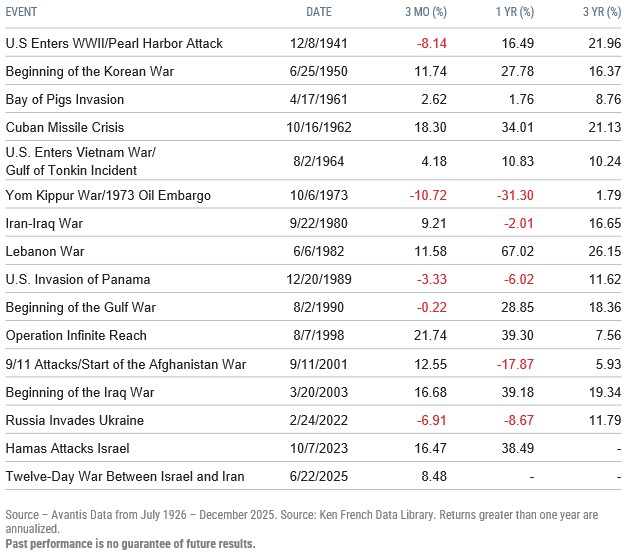
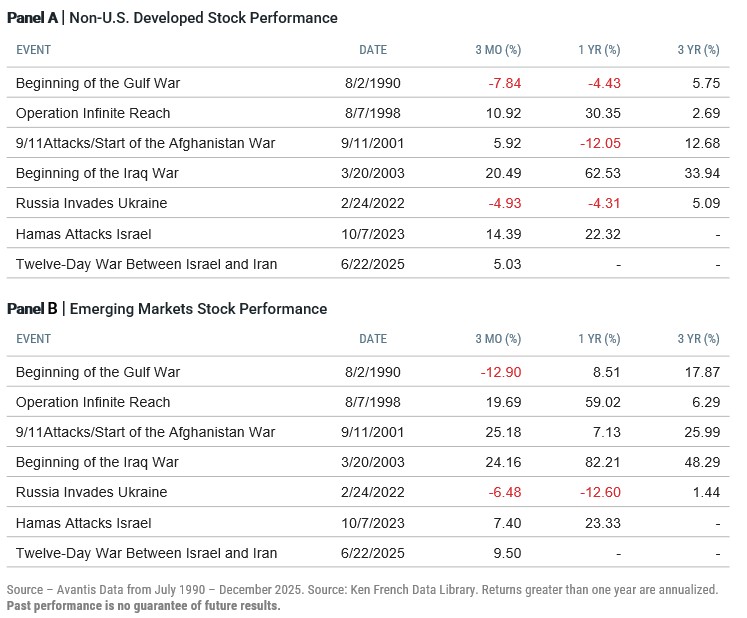
Figure 2: Non-U.S. Stocks, Like the U.S. Have Benefited Investors Who Stay the Course Through Geopolitical Conflicts
Discipline Pays Through the Power of Compounding
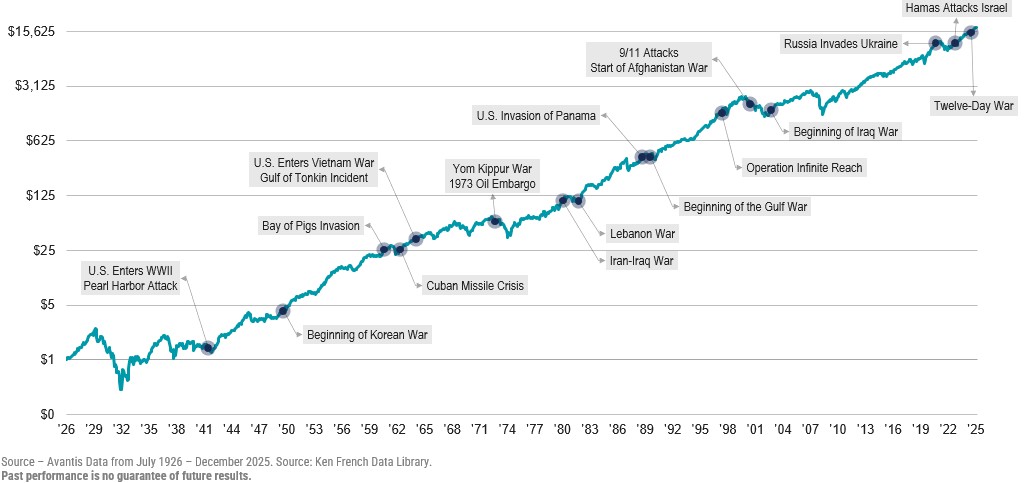
Framed another way, we can see what these returns become when allowed to compound over time.
One dollar invested in U.S. stocks would have grown to $15,625 over the past 100 years, despite a regular cadence of geopolitical uncertainty. As long-term investors, compounding is the most powerful force on our side, and history shows that interrupting it unnecessarily can be costly.
Figure 3: Growth of $1 Invested in U.S. Stocks Since 1926
Meaning for Long-Term Investors
Markets have repeatedly demonstrated resilience in the face of geopolitical uncertainty due to the many inputs that drive markets, their forward-looking nature, and the proven adaptability of the global economy.
Recognizing the market’s long-term resilience does not mean geopolitical events should be ignored, given their complexity and human consequences. As human beings, strong emotional reactions including fear and anxiety are understandable given the impact these events can have.
But from an investment standpoint, history provides clear guidance. Letting our human response to short-term uncertainty drive investment decisions is unlikely to improve long-term outcomes.
Instead, the most consistent path forward has been staying aligned with a well-constructed financial plan and maintaining a disciplined investment strategy through changing market environments.
TCI Wealth Advisors, Inc. is an SEC registered investment advisor. This material has been prepared for informational purposes only. Due to various factors, including changing market conditions and/or applicable laws, the content may no longer be reflective of current opinions or positions. No client or prospective client should assume that any information contained herein serves as the receipt of, or a substitute for, personalized advice from TCI, or from any other investment professional. Please remember that different types of investments involve varying degrees of risk, and there can be no assurance that the future performance of any specific investment or investment strategy (including those undertaken or recommended by TCI), will be profitable or equal any historical performance level(s). No amount of prior experience or success should be construed that a certain level of results or satisfaction will be achieved if TCI is engaged, or continues to be engaged, to provide investment advisory services.

